
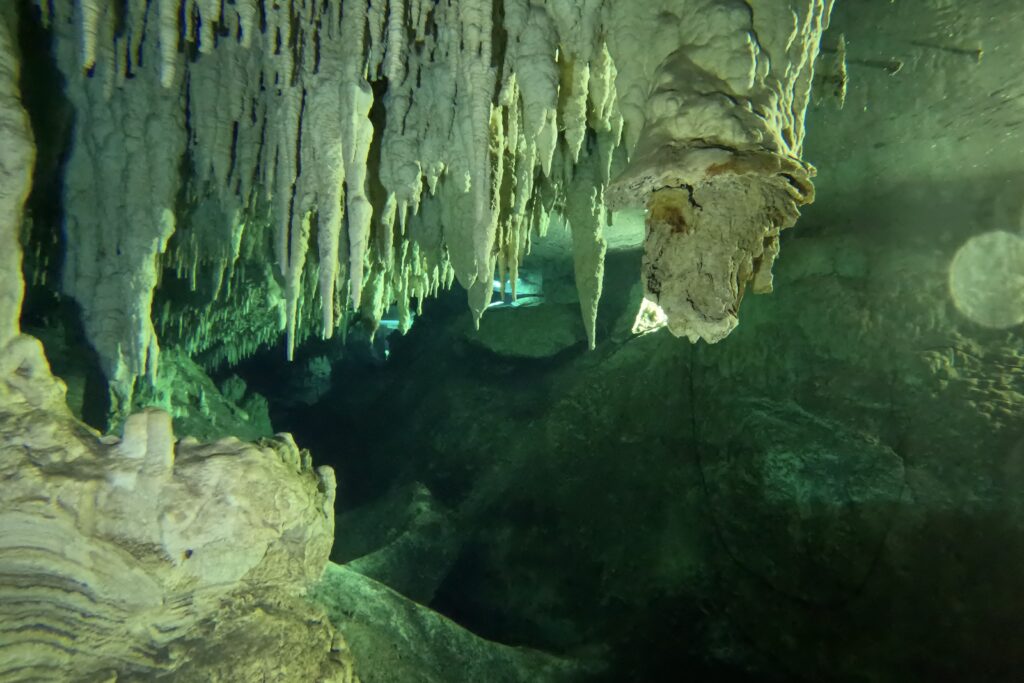
Cenote diving is one of the most unique scuba experiences in Mexico, but it is also one of the dive activities people ask the most safety questions about.
If you are wondering “Is cenote diving safe?” or “Are cenotes dangerous?”, the honest answer is: cenote diving can be safe when it is done correctly, with certified divers, a qualified guide, conservative planning, proper briefing, good buoyancy, and respect for the cavern environment.
It is not the same as jumping into a cave without training. Recreational cenote diving in the Riviera Maya is normally done as a guided cavern dive, not a technical cave dive.
Fast answer: Recreational cenote diving can be safe when it stays within guided cavern limits, with certified divers, visible natural light, a permanent guideline, small groups, proper equipment checks, good buoyancy, and a professional cenote guide. The risk increases when divers ignore rules, go beyond their training, leave the route, stir up silt, or treat cenotes like normal ocean dives.
Is Cenote Diving Safe?
Yes, cenote diving can be safe when it is planned and guided properly. Many certified recreational divers visit the cenotes every year and have safe, beautiful dives.
But cenote diving deserves respect. A cenote is not the same as a shallow reef. You may be diving in freshwater, under rock formations, with lower light in some areas, and with fragile formations that took thousands of years to develop.
The key is to understand the difference between a guided recreational cavern dive and technical cave diving. Most visiting certified divers are not doing cave diving. They are joining a guided cavern route designed for recreational divers.
Why Do People Ask If Cenotes Are Dangerous?
People ask if cenotes are dangerous because cenotes are often connected with caves, overhead environments, and accident stories online. That creates confusion.
Some online stories about cave diving accidents involve divers going beyond recreational limits, entering cave systems without proper cave training, leaving safe routes, or making serious planning mistakes. That is very different from a guided recreational cavern dive.
It is still important to be honest: cenote diving has real risks if divers ignore instructions, are not comfortable with basic skills, or go beyond their certification and experience. The solution is not fear. The solution is correct planning, conservative guide decisions, and choosing the right cenote route for your level.
Cenote Diving vs Cave Diving: The Important Difference
This is the most important safety distinction.
Recreational cenote diving for visiting divers is usually cavern diving. That means the dive stays in the cavern zone, where natural light remains visible and the route is guided. Xico Dive Center’s cenote dives are guided cavern dives in the illuminated cavern zone, where natural light remains visible and a permanent guideline leads back to the entrance. See our cenote diving in Playa del Carmen options.
Cave diving is different. Cave diving goes beyond the recreational cavern zone into a full overhead environment and requires specialized cave-diving training, equipment, planning, and procedures.
Simple difference: A guided recreational cavern dive stays within strict limits and is suitable for certified recreational divers with the right skills. Cave diving goes beyond those limits and requires technical cave training.
What Makes Recreational Cenote Diving Safer?
Several safety systems work together during a proper cenote dive. No single rule makes a dive safe by itself. The safety comes from the full system: diver certification, guide experience, route choice, briefing, equipment checks, small groups, buoyancy, and staying within the planned cavern route.
Guided cavern routes
You do not randomly explore a cenote. You follow a planned route with your guide. The guide knows the cenote, the entry and exit points, the line, the light zones, the restrictions, and the correct route for the group level.
Small groups
Small groups are important in cenotes. The guide needs to see the divers, monitor comfort, watch buoyancy, manage spacing, and adjust the pace when needed.
Large groups are harder to control in overhead or low-light environments. That is why small-group planning is an important safety factor.
Permanent guideline and visible light zone
Recreational cavern dives follow established routes. A permanent guideline helps mark the route and leads back toward the exit. Divers should not leave the planned route or swim into side passages “just to look.”
Natural light is another important part of cavern diving. Recreational cenote divers should stay within the planned cavern limits, not push into full cave areas.
Detailed briefing and equipment checks
Before entering the water, your guide should explain the route, hand signals, lights, group order, entry and exit, depth, air checks, spacing, and emergency procedures.
Divers should check gear, weights, air, lights, comfort, and fit before the dive. If something feels wrong before entering the water, fix it before the dive starts.
Buoyancy and fin control
Good buoyancy is one of the biggest safety factors in cenotes. The goal is to stay controlled, avoid touching formations, avoid kicking the bottom, and avoid creating silt.
Bad finning can reduce visibility for the group. In cenotes, a frog kick or controlled finning style is often better than big downward flutter kicks.
Who Can Safely Do a Cenote Dive?
Cenote diving is for certified divers. It is not a Discover Scuba Diving activity and it is not for non-divers.
Many easier cenote routes can be suitable for Open Water certified divers, depending on the cenote, conditions, guide decision, and the diver’s comfort. But certification alone is not the only question.
You should also be comfortable with:
- Equalizing during descent
- Breathing calmly underwater
- Basic buoyancy control
- Following a guide closely
- Keeping good spacing from other divers
- Communicating early if you feel uncomfortable
- Not touching the bottom, ceiling, or formations
If you are certified but rusty, a PADI ReActivate Refresher Course can be the safer first step before cenote diving.
Who Should Not Do Cenote Diving Yet?
Cenote diving is not the right first step for everyone. You should wait, refresh, or choose an easier dive first if you are not comfortable with basic scuba skills.
You may not be ready for cenote diving yet if:
- You are not scuba certified
- You panic easily underwater
- You cannot equalize reliably
- You are not comfortable with mask clearing
- You struggle to control buoyancy
- You have not dived in years and feel rusty
- You are uncomfortable in lower-light environments
- You do not want to follow a strict guided route
That does not mean you can never dive cenotes. It may simply mean you should start with a local reef dive, refresher, or easier training day first.
What Are the Main Risks of Cenote Diving?
The main risks of cenote diving are manageable when divers stay within limits and follow procedures. Problems usually come from ignoring the guide, poor buoyancy, poor air awareness, entering areas beyond training, or letting stress turn into panic.
Going beyond your training
Recreational divers should not enter cave areas or explore beyond the planned cavern route. If a sign, guide, or route tells you not to continue, do not continue.
Poor buoyancy and silting
Silt is fine sediment that can reduce visibility if disturbed. Bad finning, kicking the bottom, or touching the environment can create a silt cloud. This is one reason buoyancy and frog-kick control matter in cenotes.
Stress or panic
Cenotes can feel calm, but they are still a different environment from the ocean. If you feel stress building, signal your guide early. Do not hide the problem.
Ignoring air checks
Air awareness is important on every dive, but especially in cavern environments. Your guide will explain when and how air checks are done. Communicate honestly and early.
Touching formations
Cenote formations are fragile. Touching, kicking, or grabbing formations can damage something that took thousands of years to form. Good safety also means protecting the cenote.
How Cenote Dives Are Planned Safely
A safe cenote dive starts before anyone enters the water. The route is chosen based on the cenote, diver level, certification, recent experience, comfort, air consumption, depth, and conditions.
The guide explains the dive plan, route, limits, communication, lights, group order, and what to do if someone feels uncomfortable. Divers follow the guide and stay inside the planned recreational cavern route.
This is why it matters to tell the dive center your real certification level, last dive date, number of logged dives, and whether you have done cenotes before.
How Xico Dive Center Manages Cenote Safety
At Xico Dive Center, cenote safety starts with choosing the right route for the diver, not just selling the most exciting-sounding cenote.
Before recommending a cenote route, we want to know:
- Your certification level
- Your last dive date
- Your approximate number of logged dives
- Whether you have dived cenotes before
- Your comfort with buoyancy and equalization
- Whether you are nervous, rusty, or recently certified
Some divers are ready for deeper or more advanced cenote combinations. Others are better matched with beginner-friendly cenotes first. The safest choice is the route that fits your real level.
If you are not sure which option fits you, the main cenote diving page explains the available routes, levels, inclusions, and booking details.
Safety Rules for Cenote Divers
These rules are simple, but they matter.
- Stay with your guide.
- Do not leave the planned route.
- Do not swim into side passages.
- Follow the briefing and group order.
- Check your air and communicate honestly.
- Use calm, controlled finning.
- Do not touch formations.
- Do not kick the bottom or ceiling.
- Do not take anything from the cenote.
- Signal early if you are uncomfortable.
- Do not treat cenotes like normal ocean dives.
Is Cenote Diving Safe for First-Time Cenote Divers?
Yes, cenote diving can be safe for first-time cenote divers if they are certified, comfortable with basic skills, and choose a suitable beginner-friendly route.
Your first cenote dive should not be the most advanced cenote combination available. For many divers, the best first cenote route is one with easier access, beautiful light, clear water, and a calm profile.
If you are nervous or have not dived recently, be honest before booking. A local reef dive or refresher first may make your first cenote experience much more enjoyable.
Is Cenote Diving Safe for Open Water Divers?
Many cenote dives can be suitable for Open Water divers, but it depends on the route and the diver. Open Water certification alone does not automatically mean every cenote is the right choice.
For easier cenotes, Open Water divers should still be comfortable with buoyancy, equalization, mask clearing, air checks, and following a guide. For deeper or more advanced cenotes, Advanced Open Water, recent dive experience, or better buoyancy control may be recommended.
If you want to build more confidence before advanced cenote routes, the Advanced Open Water Course can help with deeper-dive awareness, buoyancy, navigation, and overall comfort.
Is Cenote Diving Safer Than Ocean Diving?
Cenote diving and ocean diving have different risks.
Cenotes usually do not have waves, boat traffic, or ocean current. Visibility can be excellent, and the water can feel calm. But cenotes may include overhead rock formations, lower-light areas, fragile environments, and the need to follow a strict route.
Ocean diving can involve current, waves, surge, boat procedures, and marine life. Cenote diving can involve cavern procedures, buoyancy precision, lights, and more discipline with route-following.
Neither is automatically “safer” in every situation. The safer dive is the one that matches your training, comfort, guide, conditions, and plan.
Safety Also Means Protecting the Cenote
Cenotes are not just dive sites. They are fragile freshwater environments and part of an important natural system in the Riviera Maya.
Good cenote divers move slowly, keep neutral buoyancy, avoid touching formations, avoid stirring silt, and do not leave trash or take anything from the site.
Safety is not only about the diver. It is also about protecting the water, the formations, and the experience for the next group.
Frequently Asked Questions About Cenote Diving Safety
Are cenotes dangerous?
Cenotes can be dangerous if divers ignore rules, go beyond their training, enter cave areas without cave certification, or have poor buoyancy and air awareness. Guided recreational cavern dives are planned to reduce these risks, but divers still need to follow the guide and stay within limits.
Is cenote diving safe for beginners?
Cenote diving can be safe for beginner cenote divers who are already scuba certified and comfortable with basic skills. It is not for non-certified divers or Discover Scuba Diving participants.
Do I need cave certification to dive cenotes?
Not for guided recreational cavern dives that stay within cavern limits. Cave certification is required for full cave diving beyond recreational cavern routes.
What is the difference between cavern diving and cave diving?
Cavern diving stays within recreational cavern limits, with natural light visible and a guided route. Cave diving goes beyond those limits into a full overhead environment and requires specialized cave training and equipment.
Can Open Water divers do cenote dives?
Many easier cenote routes may be suitable for Open Water divers, depending on the diver’s comfort, recent experience, guide decision, and route. More advanced cenotes may require more experience or Advanced Open Water.
What makes cenote diving risky?
The main risks include going beyond training, leaving the guided route, poor buoyancy, silting, poor air awareness, stress or panic, and ignoring the guide’s instructions.
What if I feel nervous in a cenote?
Tell your guide before the dive and signal early underwater if you feel uncomfortable. Do not hide anxiety. A good guide can slow the pace, adjust the plan, or end the dive safely if needed.
Should I do a refresher before cenote diving?
If you have not dived recently or do not feel confident with buoyancy, mask clearing, equalization, safety stops, or air checks, a refresher is a smart choice before cenote diving.
Can non-divers do cenote diving?
No. Cenote scuba diving is for certified divers. Non-divers can visit some cenotes for swimming or snorkeling through separate tours, but they cannot join guided cenote scuba dives without certification.
Are cenotes claustrophobic?
Some divers feel nervous because cenotes are different from open ocean dives. Recreational cavern routes still stay within limits, but if you are very uncomfortable in lower-light or overhead environments, tell the dive center before booking.
Final Thoughts: Cenote Diving Is Safe When It Is Done Correctly
Cenote diving can be one of the most beautiful scuba experiences in Mexico. It can also be very safe when divers respect the environment, stay within recreational cavern limits, follow the guide, and choose the right route for their level.
The safest cenote dive is not always the most famous or most advanced one. It is the dive that fits your certification, recent experience, buoyancy, comfort, and goals.
If you are interested in cenote diving in Playa del Carmen, tell Xico Dive Center your certification level, last dive date, approximate number of dives, and whether you have done cenotes before. We will help you choose the route that makes the most sense for your experience.