
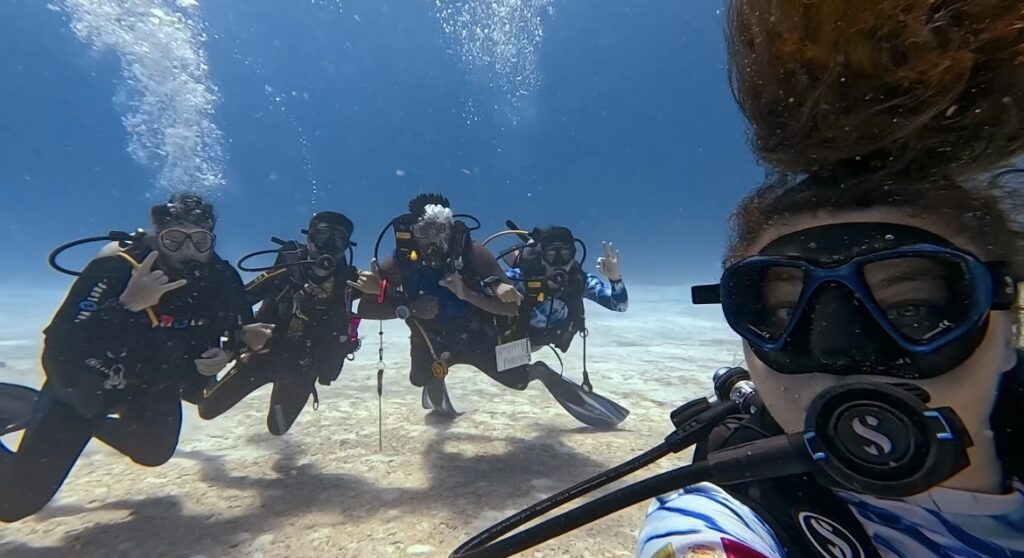
A good dive buddy does more than swim next to you underwater. A good buddy helps make the dive safer, calmer, more organized, and more enjoyable for the whole group.
Being a respectful diver also means thinking beyond yourself. Your behavior affects your buddy, your guide, other divers, the boat crew, marine life, coral reefs, cenotes, and the dive site itself.
This guide explains how to be a good dive buddy, how to communicate underwater, what good diving etiquette looks like, and how to avoid the small mistakes that can create stress for everyone else.
Fast answer: A good dive buddy communicates clearly, stays close enough to help, does proper buddy checks, respects the guide’s plan, monitors air, controls buoyancy, avoids touching marine life, and thinks about the whole group, not only their own dive.
What Makes a Good Dive Buddy?
A good dive buddy is aware, calm, honest, and easy to communicate with. They do not disappear underwater, ignore the plan, rush the group, hide problems, or treat the dive like a solo activity.
The best buddy is not always the most experienced diver. A newer diver with good awareness and honest communication can be a better buddy than an experienced diver who is careless or overconfident.
Good buddy behavior starts before the dive, continues underwater, and finishes after everyone is safely back on the boat or shore.
Talk Before the Dive
Before the dive, talk with your buddy. This does not need to be complicated, but you should both understand the basic plan.
- Confirm the dive plan and maximum depth.
- Review hand signals.
- Agree how often you will check air.
- Know who leads and who follows if needed.
- Talk about comfort level and recent experience.
- Confirm what to do if separated.
- Ask questions before entering the water.
If you are nervous, rusty, newly certified, or unsure about something, say it before the dive. A good buddy would rather know early than discover it underwater.
Do a Real Buddy Check
A buddy check should not be a fake ritual. It is a quick safety habit that can catch problems before the dive begins.
Before entering the water, check:
- BCD inflation and deflation
- Weights and releases
- Tank valve and pressure
- Primary regulator and alternate air source
- Computer or gauges
- Mask, fins, and exposure protection
- Loose or dangling equipment
A good buddy check is not about being annoying. It is about helping each other enter the water ready.
Stay Close Enough to Help
A buddy who is too far away is not really a buddy. You do not need to swim shoulder-to-shoulder the entire dive, but you should stay close enough to communicate and respond if something happens.
If your buddy has a problem, needs to signal, loses buoyancy, or gets low on air, distance matters. A good buddy stays aware without crowding the other diver.
In current, lower visibility, cenotes, swim-throughs, or deeper dives, staying close becomes even more important.
Use Clear Underwater Communication
Underwater communication should be simple and clear. Use standard hand signals, make eye contact, and wait for your buddy to respond.
Important signals include:
- OK
- Not OK / problem
- Low air
- Out of air
- Go up
- Go down
- Stop
- Slow down
- Equalization problem
- Look / point of interest
Do not assume your buddy understood you. Good communication includes confirmation.
Monitor Your Air and Share It Honestly
Air checks are not a competition. Do not hide your air pressure because you are embarrassed, and do not wait until you are very low before saying something.
A good buddy checks their own air often and pays attention when the guide or buddy asks. If you are using air faster than expected, communicate early.
A safe dive ends with a reserve. It should not become a last-minute rush to the surface.
Respect the Guide’s Plan
The guide’s plan is based on the dive site, conditions, group level, visibility, current, depth, time, and safety judgment.
A respectful diver does not leave the route, go deeper without permission, chase animals, enter swim-throughs alone, or pressure the group into doing something different.
If you want a specific type of dive, say it before booking or before the dive. Underwater is not the time to redesign the plan.
Control Your Buoyancy
Good buoyancy is one of the clearest signs of a respectful diver. It protects the reef, makes the dive calmer, and helps the group stay organized.
Poor buoyancy can cause accidental contact with coral, sand, cenote formations, other divers, or marine life. It can also make your buddy work harder because they have to watch you instead of enjoying the dive.
If buoyancy is difficult for you, start with easier dives, check your weighting, move slowly, and consider training focused on buoyancy control.
Do Not Touch Coral or Marine Life
A respectful diver looks, enjoys, and leaves marine life alone. Do not touch, chase, feed, grab, block, or harass animals.
Do not touch coral, stand on reef, kneel on formations, or use the bottom to stabilize yourself for photos.
For more detailed reef-protection habits, read our guide to eco-friendly dive practices.
Be Aware of Other Divers
Good etiquette also means knowing where other divers are around you.
- Do not kick someone in the face with your fins.
- Do not swim over another diver’s head if you can avoid it.
- Do not block narrow swim-throughs or the guide’s path.
- Do not crowd a diver taking a photo.
- Do not push in front of others to see marine life.
- Do not stir up sediment with careless kicks.
Small awareness habits make the dive better for everyone.
Boat Etiquette for Divers
Boat etiquette matters, especially when several divers are preparing at the same time.
- Keep your gear organized.
- Do not block walkways with loose equipment.
- Listen to the boat and dive briefing.
- Be ready when it is your turn to enter.
- Be careful with tanks, weights, fins, and cameras.
- Respect the crew’s instructions.
- Give other divers space to set up.
A boat feels much easier when every diver is organized and respectful.
Photo and Video Etiquette
Underwater photos and videos are great, but cameras can make divers forget their buddy, buoyancy, and surroundings.
If you bring a camera:
- Control your buoyancy before filming.
- Do not chase animals for a shot.
- Do not touch the reef to stabilize yourself.
- Do not block the group for too long.
- Keep lights, mounts, and accessories secured.
- Check on your buddy, not only your camera screen.
The best underwater content comes from calm divers who respect the reef and the group.
What If Your Buddy Has a Problem?
If your buddy signals a problem, stay calm and respond clearly. Do not panic, rush upward, or ignore the signal.
Simple buddy support includes:
- Stop and make eye contact.
- Confirm the problem.
- Signal the guide if needed.
- Stay close.
- Help your buddy slow down and breathe.
- Follow the guide’s instructions.
You do not need to act like a hero. You need to stay calm, communicate, and follow safe procedures.
What If You Are the One With a Problem?
A good buddy also knows when to ask for help. Do not hide problems underwater.
Signal early if you have:
- Ear pain or equalization trouble
- Mask problems
- Low air
- Buoyancy problems
- Stress or panic
- Equipment concerns
- Cold, cramps, or discomfort
Most problems are easier to manage early. Waiting too long can make a small issue worse.
Respect Different Experience Levels
Not every diver has the same experience, comfort, or confidence. A respectful diver does not shame newer divers, pressure rusty divers, or make someone feel bad for needing an easier plan.
If your buddy is newer, be patient. If you are the newer diver, be honest. The best dive plan is one that works for the group, not only for the strongest diver.
If you are certified but rusty, a PADI refresher course may be a better first step before joining more demanding dives.
Be a Good Buddy in Cenotes
Cenotes require extra awareness because the environment is different from open ocean diving. Light, depth, buoyancy, formations, route discipline, and group control all matter.
For cenote dives, stay with the guide, follow the planned route, keep good buoyancy, avoid touching formations, and do not wander away from the group.
If you want to dive cenotes, choose a plan that matches your certification, buoyancy, and comfort level. You can learn more on our cenote diving page.
Be a Good Buddy on Local Reef Dives
Local reef dives are a great place to practice good buddy habits because you can focus on air checks, communication, buoyancy, marine life awareness, and staying with the group.
If you are current and comfortable, local reef diving in Playa del Carmen can be a good first dive day before choosing more demanding dives later in the trip.
When to Build More Safety Skills
If you want to become more confident with problem prevention, assisting other divers, and emergency awareness, the PADI Rescue Diver Course is the next major step.
You do not need Rescue Diver certification to be respectful and aware, but the course can help divers understand stress, prevention, response, and how to support others more effectively.
Good Dive Buddy Checklist
| Habit | Why It Matters |
|---|---|
| Talk before the dive | Confirms plan, signals, comfort level, and expectations |
| Do a buddy check | Catches equipment problems before entering the water |
| Stay close enough | Allows communication and support if needed |
| Check air often | Prevents low-air surprises and rushed ascents |
| Use clear signals | Reduces confusion underwater |
| Control buoyancy | Protects the reef, the group, and the diver |
| Respect marine life | Keeps animals calm and protects the environment |
| Follow the guide | Keeps the dive organized and within the safety plan |
Ready to Dive With a Better Plan?
Tell us your certification level, last dive date, approximate number of logged dives, and what kind of diving you want to do.
We will recommend a dive plan that fits your level, comfort, and the daily conditions, so you can enjoy the dive while being a good buddy and respectful diver.
Frequently Asked Questions About Dive Buddies and Diving Etiquette
What makes someone a good dive buddy?
A good dive buddy communicates clearly, does proper buddy checks, stays close enough to help, monitors air, respects the guide’s plan, controls buoyancy, and speaks up if something feels wrong.
How close should I stay to my dive buddy?
You should stay close enough to communicate and respond if needed. The exact distance depends on visibility, current, dive site, group size, and the dive plan.
What is a buddy check?
A buddy check is a quick pre-dive equipment and safety check. Divers confirm BCD function, weights, air, releases, regulators, computer or gauges, and general readiness before entering the water.
What is good scuba diving etiquette?
Good scuba diving etiquette means respecting your buddy, guide, boat crew, other divers, marine life, coral, and local rules. It includes good buoyancy, clear communication, no touching, and staying with the plan.
What should I do if my buddy has a problem underwater?
Stay calm, make eye contact, confirm the problem, signal the guide if needed, stay close, and follow safe procedures. Do not panic or rush upward.
Can I dive if I do not have a buddy?
Most recreational divers should dive with a buddy, guide, or organized group. Solo diving requires specific training, equipment, and procedures and is not the standard approach for most recreational dives.
Why is buoyancy part of good diving etiquette?
Good buoyancy helps protect coral, marine life, cenote formations, visibility, and other divers. Poor buoyancy can damage the environment and create stress for the group.
Is it okay to touch marine life while diving?
No. Respectful divers do not touch, chase, feed, grab, or harass marine life. Watch calmly from a safe distance and let animals behave naturally.
What is good boat etiquette for divers?
Good boat etiquette means keeping gear organized, listening to briefings, giving other divers space, respecting the crew, being ready when it is your turn, and handling tanks, weights, fins, and cameras carefully.
How can I become a more confident buddy?
Practice communication, buoyancy, air monitoring, buddy checks, and awareness on every dive. If you want more formal training in problem prevention and emergency awareness, the Rescue Diver course is a strong next step.
Final Thoughts
Being a good dive buddy is not about being perfect or having the most dives. It is about awareness, communication, respect, and good decisions.
When you are a better buddy, the dive is safer, calmer, and more enjoyable for everyone: your buddy, your guide, the group, the reef, and yourself.