Trying scuba diving for the first time is exciting, but it is also normal to feel nervous. You may wonder if scuba diving is safe, how deep you will go, whether you need to be a strong swimmer, what happens if you panic, or what it feels like to breathe underwater.
The good news is that your first scuba dive does not need to be complicated. With a professional instructor, clear briefing, shallow-water practice, and beginner-friendly dive sites, many first-time divers are surprised by how calm and natural the experience feels once they are in the water.
This beginner guide explains what to expect on your first scuba dive, how Discover Scuba Diving works, what skills you practice, what questions beginners usually ask, and why Playa del Carmen is one of the best places in Mexico to try scuba diving for the first time.
Fast answer: Your first scuba dive usually starts with a short briefing, equipment setup, and shallow-water skill practice. Then, with your instructor by your side, you make a guided ocean dive at an easy beginner-friendly reef. If you are not certified yet, the best first step is Discover Scuba Diving. If you want to become certified, choose the PADI Open Water Course.
What Is Your First Scuba Dive Like?
Your first scuba dive is usually much slower and calmer than people imagine. You are not dropped into deep water alone. You start with an instructor, a clear explanation, and enough time to get comfortable with the equipment.
At first, breathing underwater can feel strange because your brain is used to breathing at the surface. After a few minutes, most beginners relax and start focusing on the reef, the fish, and the feeling of floating weightlessly.
The goal of a first dive is not to make you a perfect diver. The goal is to help you experience the underwater world safely, calmly, and with direct instructor supervision.
Do You Need to Be Certified for Your First Scuba Dive?
No. If you only want to try scuba diving, you do not need to be certified. The best option is Discover Scuba Diving in Playa del Carmen.
Discover Scuba Diving is designed for people who are not certified yet. It is not a full certification course, but it lets you experience real scuba diving with an instructor after learning the basic rules and practicing a few important skills.
If you want to become a certified diver and dive independently with a buddy in the future, then the right choice is the PADI Open Water Course.
Discover Scuba Diving vs Open Water Course
Many beginners are not sure if they should do Discover Scuba Diving or the Open Water Course. The difference is simple.
| Option | Best For | Result |
|---|---|---|
| Discover Scuba Diving | People who want to try scuba for the first time | A beginner experience, not a certification |
| PADI Open Water Course | People who want to become certified divers | International scuba certification |
If you are curious but not ready to commit to a full course, start with Discover Scuba Diving. If you already know you want to continue diving after your vacation, the Open Water Course is the better long-term choice.
What Happens Before Your First Dive?
Your first dive starts before you enter the ocean. The instructor explains how scuba diving works, what the equipment does, how to breathe through the regulator, how to equalize your ears, and what basic safety rules you need to follow.
You will also learn simple hand signals. Because divers cannot talk normally underwater, hand signals are used to communicate things like “OK,” “go up,” “go down,” “problem,” or “look here.”
This briefing is important because it removes a lot of fear. Beginners usually feel much better once they understand what will happen step by step.
What Equipment Do You Use?
For your first dive, the dive center provides the scuba equipment. You do not need to buy your own gear.
You will normally use:
- Mask: lets you see underwater
- Fins: help you move efficiently
- BCD: helps you float at the surface and control buoyancy underwater
- Regulator: lets you breathe from the tank
- Tank: holds the air you breathe underwater
- Weights: help balance your natural buoyancy
- Wetsuit or exposure protection: keeps you comfortable in the water
Your instructor helps you set up, adjust, and check everything before the dive. The equipment may feel unusual at first, but you do not need to understand every technical detail before your first dive.
What Skills Do You Practice Before the Ocean Dive?
Before heading to the reef, beginners usually practice a few basic skills in shallow or controlled water. These skills help you feel more comfortable and prepared.
You may practice:
- Breathing through the regulator
- Clearing a little water from your mask
- Recovering or clearing the regulator
- Equalizing your ears
- Basic hand signals
- Floating and staying relaxed
These skills are not meant to scare you. They are there to show you that small problems underwater can be handled calmly with your instructor’s help.
How Deep Do You Go on Your First Scuba Dive?
Your first dive is normally shallow. During Discover Scuba Diving, the maximum depth is usually 12 m / 40 ft.
That does not mean every first dive goes to the maximum depth. Your instructor chooses the dive plan based on safety, comfort, conditions, and how the group feels in the water.
Beginner dives are designed to be relaxed and controlled. You should never feel rushed into going deeper than you are comfortable with.
Is Scuba Diving Safe for Beginners?
Scuba diving can be safe for beginners when it is done with professional supervision, proper equipment, suitable conditions, and clear instructions.
The most important safety factors are:
- Listening to the instructor
- Breathing continuously
- Equalizing early and often
- Staying close to the instructor
- Communicating if something feels wrong
- Not touching marine life or the reef
- Taking your time
Good beginner diving is not about being brave. It is about being honest, calm, and willing to follow instructions.
Do You Need to Be a Strong Swimmer?
You do not need to be an Olympic swimmer to try scuba diving, but you should be comfortable in the water.
You should be able to float, move calmly, and follow the instructor’s directions. If you are afraid of water, cannot swim at all, or panic easily in water, tell the dive center before booking.
Comfort in the water matters more than swimming speed. Scuba diving is slow. You are not racing, and you do not need to swim hard.
What If You Feel Nervous Before Your First Dive?
Feeling nervous before your first dive is completely normal. Many first-time divers are nervous about breathing underwater, wearing the gear, equalizing, or seeing marine life.
The best thing you can do is tell your instructor. Do not hide it. A good instructor can slow down, explain more, help you practice, and make sure you are comfortable before continuing.
Most nervous beginners relax after the first few minutes underwater. Once they realize they can breathe, float, and move slowly, the fear often turns into excitement.
What If You Panic Underwater?
Panic is uncommon, but it can happen. The most important rule is to stop, breathe, and signal your instructor.
Your instructor is trained to help nervous divers. You are not expected to solve every problem alone on your first dive.
If you feel uncomfortable, communicate early. Do not wait until stress becomes panic. A beginner dive can always slow down, pause, or end safely if needed.
How Do You Equalize Your Ears?
As you go down, pressure changes and your ears need to equalize. This is normal.
Most beginners equalize by gently pinching the nose and blowing softly, or by swallowing or moving the jaw. The important thing is to equalize early and often, before pain starts.
If your ears hurt, stop descending and signal your instructor. Never force your ears and never continue down through pain.
What Can You See on Your First Dive in Playa del Carmen?
Playa del Carmen is a great place for a first scuba dive because the local reefs are close to shore, colorful, and full of life.
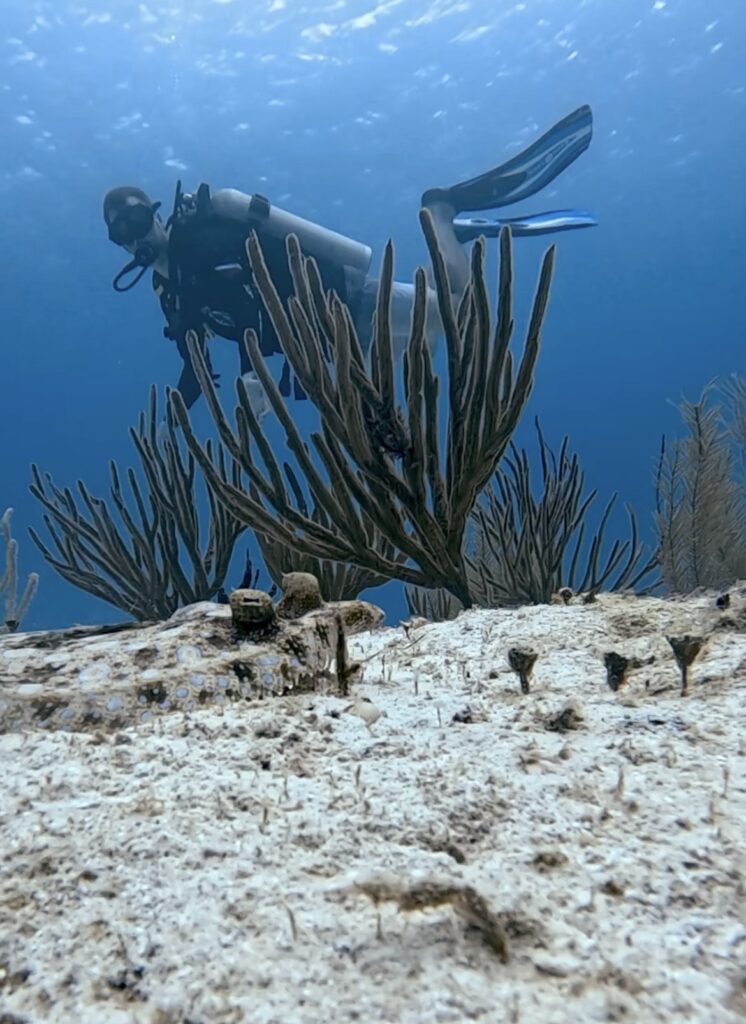
On a beginner-friendly reef dive, you may see tropical fish, coral formations, sea fans, sponges, rays, moray eels, turtles, or other Caribbean marine life. Sightings are never guaranteed, but the reefs here are a beautiful introduction to the underwater world.
The best part is often not one specific animal. For many beginners, the unforgettable moment is the feeling of breathing underwater for the first time.
Why Playa del Carmen Is Good for Beginner Scuba Divers
Playa del Carmen is one of the best places in Mexico to try scuba diving because it offers warm Caribbean water, local reefs close to town, professional dive centers, and many dive sites suitable for first-time divers.
The reefs are usually much easier for beginners than more advanced dives like cenotes, deep dives, wreck dives, or bull shark dives. Those experiences can come later after certification and more experience.
For a first dive, you want clear instructions, easy logistics, and a reef that lets you focus on breathing, floating, and enjoying the experience. Playa del Carmen is strong for exactly that.
What Should You Bring?
You do not need to bring scuba equipment for your first dive. The dive center provides the main gear.
Bring:
- Swimsuit
- Towel
- Dry clothes for after the dive
- Water bottle
- Reef-safe sun protection
- Any required medical information
- A light meal in your stomach, not a heavy one
Avoid heavy alcohol the night before diving. Sleep, hydration, and a calm morning make the experience much easier.
Can Kids Try Scuba Diving?
Yes, kids can try scuba diving if they meet the age, comfort, and safety requirements for the right program.
For children 10 years and older, Discovery Scuba Diving for Kids is the better page to visit. It is made for kids and families, includes a theory session, pool practice, and two guided ocean dives with an instructor.
For younger kids, PADI also has pool-based youth programs like Bubblemaker and Seal Team. These are shallow, controlled introductions to scuba, not full ocean certification programs.
If your child is 10 or older and wants to become certified, the Junior Open Water Course may be the right next step. Children younger than 15 earn a Junior Open Water certification, which can later be upgraded when they are old enough.
The most important question is not only age. A child should be comfortable in the water, able to listen carefully, and genuinely interested. A first scuba experience should feel fun and pressure-free, not forced.
What If You Love It?
Many people try scuba once and immediately want to continue. If that happens, the next step is scuba certification.
The PADI Open Water Course teaches the knowledge, skills, and open-water training needed to become a certified diver. At Xico Dive Center, the Open Water Course includes eLearning, pool training, and four ocean dives in Playa del Carmen.
After certification, you can continue with local reef dives, Cozumel, cenotes, night diving, Advanced Open Water, and many other scuba experiences.
Frequently Asked Questions About Your First Scuba Dive
Can I scuba dive without certification?
Yes, you can try scuba diving without certification through Discover Scuba Diving. You must dive under instructor supervision and follow the program limits. It is not the same as being certified.
Is Discover Scuba Diving a certification?
No. Discover Scuba Diving is a beginner experience, not a certification course. If you want to become certified, choose the PADI Open Water Course.
How deep is your first scuba dive?
During Discover Scuba Diving, the maximum depth is usually 12 m / 40 ft, but the actual depth depends on the instructor, conditions, and comfort level.
Is scuba diving scary the first time?
It can feel scary before you start because it is new. Many beginners relax once they practice breathing underwater and realize the instructor is with them the whole time.
What if water gets in my mask?
A little water in the mask is common and easy to clear. Your instructor will teach you how to handle it before the dive.
What if I run out of air?
Your instructor monitors the dive and your air supply. Beginner dives are planned conservatively. You also learn basic safety rules before entering the water.
Do I need to buy scuba gear?
No. For your first scuba experience, rental gear is included. Later, if you continue diving, you may decide to buy personal gear such as a mask, fins, or dive computer.
Can I touch turtles, fish, or coral?
No. Divers should never touch marine life or coral. The best encounters happen when you stay calm, keep distance, and let animals behave naturally.
Can kids try scuba diving?
Yes. Children 10 years and older can try scuba with a suitable kids scuba program if they are comfortable in the water and able to follow instructions. Kids who want certification can continue with the Junior Open Water Course.
Can I do cenote diving as my first scuba dive?
No. Cenote scuba diving is for certified divers. If you are not certified, start with Discover Scuba Diving or the Open Water Course first.
Can I do bull shark diving as a beginner?
No. Bull shark diving is for certified divers who meet experience and safety requirements. It is not a first-dive activity.
Should I do Discover Scuba Diving or Open Water?
Choose Discover Scuba Diving if you want to try scuba once before deciding. Choose Open Water if you already know you want to become a certified diver.
Final Thoughts: Your First Dive Should Feel Safe, Clear and Exciting
Your first scuba dive should not feel rushed or confusing. It should feel organized, supportive, and exciting. With the right instructor, good equipment, and beginner-friendly conditions, scuba diving can become one of the best memories of your trip.
If you want to try scuba diving in Playa del Carmen without becoming certified yet, Discover Scuba Diving is the best first step. If you want to become a certified diver, the Open Water Course is the right path.
Tell Xico Dive Center if you are nervous, traveling with family, short on time, or thinking about certification. We will help you choose the option that fits your comfort level and vacation plan.